


More than 100 rescued in Vermont floods as search efforts continue
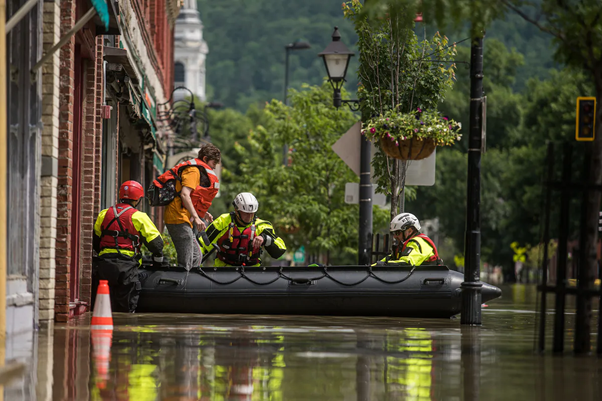
Intense flooding across Vermont trapped residents in their homes, washed out roads and set off widespread rescue efforts, a crisis that officials warned would continue at least through the week’s end.
More than 100 people had been rescued statewide by Tuesday morning, while crews on boats and in helicopters searched for others who were stranded in the rural, mountainous state, officials said. Rescuing those who were trapped was expected to take several days, state authorities said, and they feared that more rain starting Thursday could bring further devastation.
Flash floods Monday from heavy rainfall turned to river flooding Tuesday as the rain stopped and rivers across the state rose, including in the state capital, Montpelier, and throughout the Green Mountains. Some surpassed major flood stage at record-breaking levels, and a few dams neared capacity, including in hard-hit Montpelier.
The extent of the storm’s damage to roads, buildings and other infrastructure remained far from clear, but thousands of people had lost homes and businesses, and countless roads had been washed out, Gov. Phil Scott (R) said at a news briefing Tuesday.
“The devastation and flooding we’re experiencing across Vermont is historic and catastrophic,” Scott said. “This is nowhere near over.”
Residents described seeing waterfalls, mudslides, blocked roads and washed-away bridges. People across large swaths of the state were unable to leave their homes, hemmed in by water or damaged roads.
“We were totally blocked in,” said Stacey Alexander, 48, whose house sits on a curve of the West River in Londonderry. It overflowed its banks, covering the road out with several feet of water. Alexander and her husband, Huzon, rushed to move their belongings to high shelves as they watched the raging river carry away tires, trash cans and propane tanks.
A nearby bridge was closed after being damaged, while parts of roads in the area had collapsed, leaving giant scalloped edges where water still flowed beneath.
Though the sun made an appearance Tuesday, officials were bracing for more rain later this week. Vermont’s swollen rivers were set to drop below minor flood stage before Thursday’s showers, but in areas that saw the worst flooding, more flash floods prompted by late-week rain couldn’t be ruled out, said Rebecca Duell, a National Weather Service meteorologist in Burlington.
“At this point, there’s nowhere for the water to go,” she said. “It’s something we are watching closely.”
The storms began Sunday and hit Vermont, New York, Connecticut and other spots in the Northeast, killing one person in the Hudson Valley. No other deaths had been reported in Vermont as of Tuesday morning.
The torrents were a product of a slow-moving storm system trapped between areas of strong high pressure over Greenland and western Canada and fueled by a steady flow of tropical moisture feeding in from the south. The extreme weather underscored how current flood predictions based on historical data no longer keep up with a warming planet’s extreme rainfall.
The Northeast as a whole was looking at drier weather through Wednesday, Duell said, followed by possible showers and thunderstorms Thursday and Friday. In New York, teams were assessing damage as residents began recovering from more than eight inches of rain in parts of the mid-Hudson region and more than five inches in the Finger Lakes region.
In Vermont, the storms dumped six to nine inches of rain — in some places, more than two months’ worth — on parts of the state from late Sunday to early Tuesday. The combination of Vermont’s mountainous topography and tucked-away towns left many people stranded and complicated rescue efforts.
Rescue crews from multiple states were making their way to Vermont, where 13 water rescue teams, five out-of-state teams and five helicopters were already rushing to find people in hard-hit and remote areas.
The Winooski River, which flows through Montpelier, crested above 21 feet, higher than during Tropical Storm Irene in 2011 and nearly four feet above major flood stage, Duell said.
The hardest-hit regions were the Montpelier-Barre area and Ludlow, Londonderry, Andover and surrounding towns, Vermont Public Safety Commissioner Jennifer Morrison said. Ski resorts closed in Ludlow and Killington. Woodstock lost its water supply and went under a boil-water advisory. Montpelier closed its flooded downtown as officials briefly feared that a nearby dam could spill. They also urged residents to boil their water.
“People are partly in a state of shock, partly in a state of exhaustion,” said William Fraser, the Montpelier city manager. “And people are sad at what’s happened.”
Source: The Washington Post