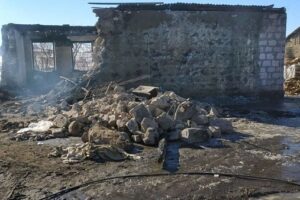




Germany floods: At least 80 dead and hundreds unaccounted for
At least 80 people have died and hundreds more are unaccounted for in Germany after some of the worst flooding in decades.
Record rainfall in western Europe caused rivers to burst their banks, devastating the region.
Belgium has also reported at least 12 dead after the extreme weather, which political leaders have blamed on climate change.
German Chancellor Angela Merkel has pledged full support for the victims.
In Germany, the states of Rhineland-Palatinate and North Rhine-Westphalia were worst hit.
During a visit to a hard-hit area, Armin Laschet, premier of North Rhine-Westphalia, blamed the extreme weather on global warming, saying climate protection measures must be accelerated.
Scientists have repeatedly warned that human-induced climate change would bring pulses of extreme rainfall such as this one.
The Netherlands is also badly affected, with further flooding in Luxembourg and Switzerland.
In the western German district of Ahrweiler, up to 1,300 people are unaccounted for, the authorities say. A spokeswoman for the local government said mobile networks had been put out of action, making it impossible to contact many people.
The village of Schuld (population 700) was almost entirely destroyed. A major dam near the Belgian border, the Rurtalsperre, is at capacity and overflowing slightly, officials say.
More heavy rain is forecast across the region on Friday.
Chronicle of a disaster foretold
Scientists have condemned politicians for failing to protect their citizens from extreme weather events such as the floods in northern Europe and the US heat dome.
They have been predicting for years that summer rainfall and heatwaves would become more intense due to human-induced climate change.
Hannah Cloke, Professor of Hydrology at the University of Reading, said: “The deaths and destruction across Europe as a result of flooding is a tragedy that should have been avoided.
“Forecasters issued alerts early in the week, and yet the warnings were not taken seriously enough and preparations were inadequate.
“The fact that other parts of the northern hemisphere are currently suffering record-breaking heatwaves and fires should serve as a reminder of just much more dangerous our weather could become in an ever-warmer world.”
Scientists say government must both cut the CO2 emissions that are fuelling extreme events, AND prepare for more extreme weather.
Yet in the UK – hit by severe flooding on Monday – the government’s advisory climate change committee recently told ministers the nation was even worse prepared for extreme weather than it was five years ago.
It said the government was keeping only a fifth of its pledges to cut emissions.
And only this week the UK government told people that they don’t need to reduce flying because technology will solve the emissions problem – a notion that most experts consider a gamble.
Some 15,000 police, soldiers and emergency service workers are at the scene to aid with search and rescue, while helicopters picked stranded residents from roof tops and tanks cleared roads of fallen trees and debris.
In the town of Erftstadt-Blessem, floodwaters caused a row of houses to collapse wholly or partially. Calls for help could be heard coming from the buildings, whose residents could only be reached by boat.
Speaking during a meeting with US President Joe Biden in Washington DC, Mrs Merkel expressed her “deepest condolences” to everyone across the region who had lost loved ones after “a day of worry and despair”.
“I fear we will only see the full extent of this tragedy in the coming days,” she said. She also pledged government support with rescue efforts and with reconstruction, saying to the German people that the government “will not leave you alone in this difficult, terrible hour”.
In Belgium, dramatic footage of the floods showed cars being swept away along a street in the city of Verviers. A curfew was in place overnight because of the risk of looting.
Residents of Liège, Belgium’s third-largest urban area after Brussels and Antwerp, were ordered to evacuate. Local officials said those unable to leave should move to the upper floors of their buildings.
The Meuse river, which flows through the city, stabilised on Friday morning, with small overflows in some areas. Officials are also concerned that a dam bridge in the area may collapse and urged people to help each other.
“The crisis situation is exceptional and solidarity must prevail,” the local authority said in a statement.
Belgium’s King Philippe and Queen Mathilde visited a crisis centre in Chaudfontaine, southeast of Liège, set up for affected residents.
In the Netherlands, King Willem-Alexander and Queen Maxima inspected damage in Valkenburg, close to the Belgian and German borders, where flooding engulfed the town centre and forced the evacuation of several nursing homes.
The country has reported no casualties but thousands of people in towns and villages along the Meuse river have been urged to leave their houses quickly.
In the Dutch city of Maastricht, 10,000 people were ordered to evacuate.
Source: BBC News